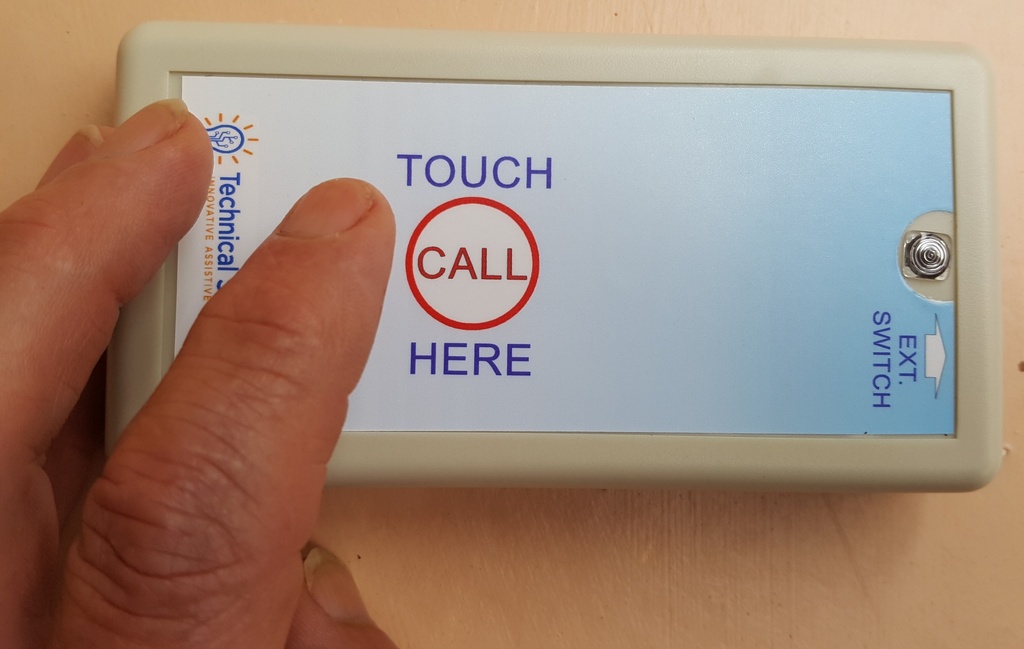
Pager Transmitter 433MHz with touch switch and switch socket.
PTX-TS
Technical Solutions’ radio pager is a simple, portable system that can be used to alert a carer when a person needs assistance. A short press of the built in touch switch or external plugged in switch sends a message to a pager (or pagers) monitored by support staff.
Multiple transmitters can communicate with one or more pager receivers, making the system expandable for use in group homes and larger situations. Text messages can be pre-programmed to communicate with suitable pager receivers to identify individual call points.
The transmitter has a strong open air radio range in excess of 300m, reducing with obstacles and interference. Standby battery life is better than 9 months with a set of fresh 2 x AA batteries. (Frequent use will reduce the battery life)
How does the PTX-TS compare with the Apollo PTX-TE-101?
We have been purchasing, adapting/modifying and on-selling the PTX-TE-101 for many years. They are a reliable product but were never designed for disability use. We have recently developed and manufactured our own single channel transmitter, the PTX-TS. The PTX-TS performs the same function as the PTX-TE-101 while being designed with accessibility features at its core. The PTX-TS is also cheaper and better supported for repairs as we make it locally, here in Silvan, Victoria. Both pager transmitters come pre-programmed, making them very easy to set up and use.
Built in touch switch
Our PTX-TS has a disability specific touch switch built in. Meaning that, for users who have adequate finger control, the pager can be activated directly via this extremely sensitive touch switch. Eliminating switch wires and the cost of an external switch. Switch wires, plugs and sockets can wear and be damaged by normal usage and are the cause of most call system failures. For this reason, a built in switch is more reliable as well as neater and easier to set up and maintain.
Note however, that a Wand Switch or Puff Switch may be better suited for those who are using face or head activation rather than finger.